What Is In a Name? The Works of Lindsay McIntyre
The title of Lindsay McIntyre's film program—What Is In A Name?—is both a point of entry and a provocation. In so many ways, Her work resists linearity. They live as a constellation of artifacts, woven through with threads of land, memory, material, and relation. The names themselves do not just mark; they locate. They tether each artifact to a time, a place, a body and more crucially, to the ongoing process of claiming and reclaiming belonging to land and one’s history.
In her work, narrative is never assumed; it is questioned, disassembled, felt. Her experimental films, grounded in a rigorous material practice, are crafted from handmade emulsions, intimate archives, fragments of life lived, personal diaries, objects collected and discarded over time, and acts of care that resist the flattening force of conventional storytelling. Her attention is not only to people and places, to her family and place in the world, but to what lingers between them: absence, inheritance, silence. She troubles the notion of what an image, or a name, can hold.
Similarly, McIntyre’s methodology foregrounds an ethical concern: for whom are these stories told, and how are they to be seen? Her practice questions colonial modes of storytelling and display, those that seek to fix, consume, or simplify. Instead, she turns toward a methodology grounded in care, opacity, and persistence. The question of legibility is not just aesthetic, but political. What does it mean for a story to be understood, and by whom? How can a film protect the people and histories it evokes, rather than expose or misrepresent them?
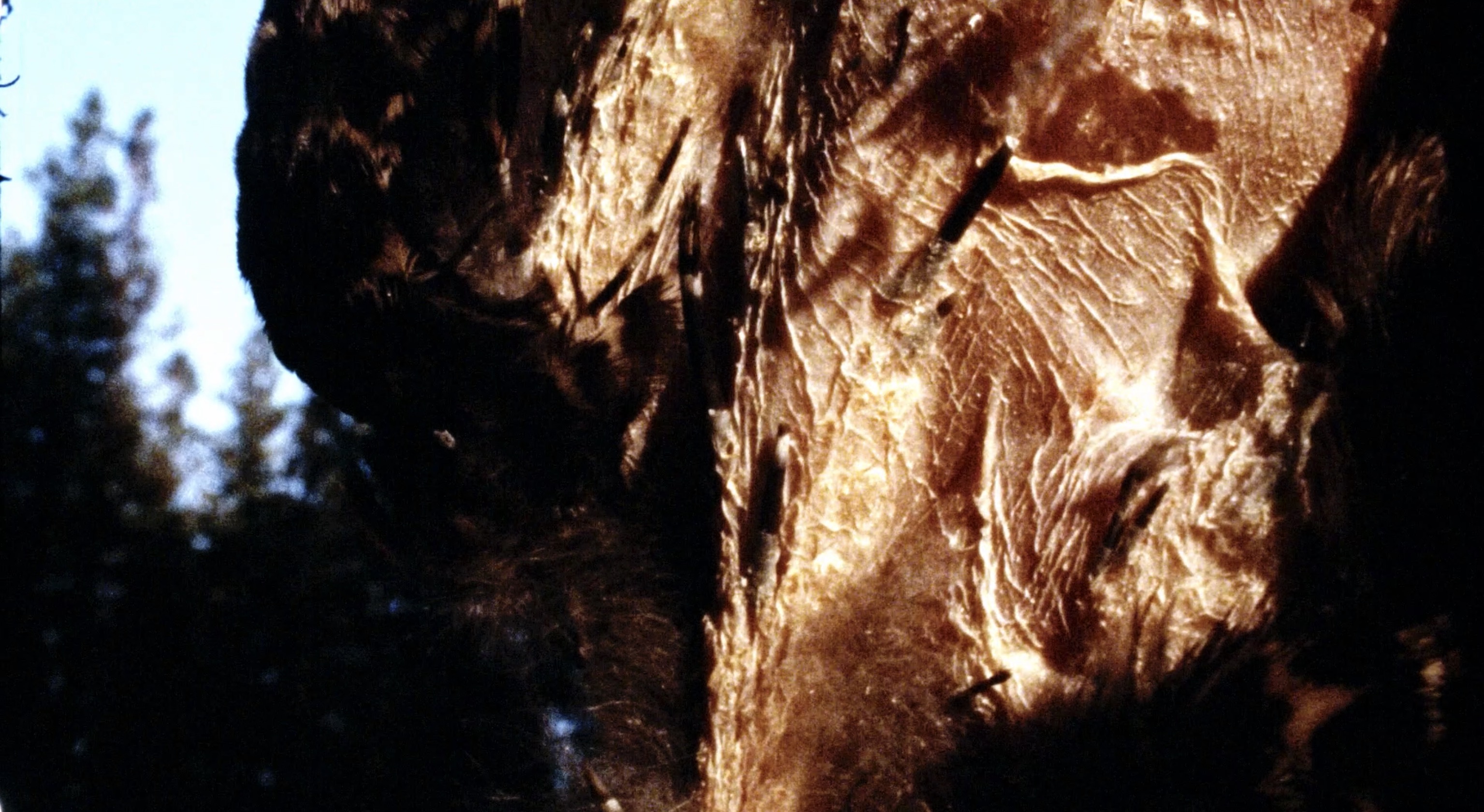
These questions sit at the heart of her films. Her approach often sits at the limits of experimental aesthetics and abstraction, not as retreat, but as resistance. This is where her intimate connection to material becomes vital. The materiality of film–the emulsion, grain, light, and chemical process–is not separate from the narrative but an echo of its instability. The fragility of the work responds directly to that of the questions she’s asking. It is a form of knowing through doing—an embodied knowledge that emerges only when one is fully immersed, lost within the frame, and attentive to what remains outside of it. With every mark, a question appears, and another recedes. The creation of each film is often rooted in long periods of studio experimentation and slow, careful observation, building a dense ecology of meaning that is as expansive as it is delicate. These are not just films; they are artifacts that bear the weight of relation, responsibility, and survival.
The films vary in duration, but also in pace and rhythm, often guided by the materiality of the object itself, be it the voice, the image, the archive or the landscape. Varying in scale and style, they complement each other to be read like chapters in a book.
In where no one knew her name and though she never spoke, this is where her voice would have been, silence becomes a presence, and the missing is made visible. These early works from The Bloodline series ask what’s left behind when someone disappears, and whether the archive, personal or familial, can ever be complete.
In All-around Junior Male, a young Nunamiut athlete performs a challenging traditional Inuit game–the one-foot high kick, as both a manifestation of cultural endurance and personal expression. Seeing Her animates McIntyre’s great-grandmother’s amauti. The beaded chest piece transforms into a filmic landscape where the laborious analogue filming mirrors that of the labour, skills, and traces that the amauti still holds within its fabric.
Her Silent Life returns to the history of Kumaa’naaq, McIntyre’s Inuk great-grandmother. It begins with what she would not leave behind—and ends in silence. Kumaa’naaq’s story is gripping and painful and is guided by intergenerational recollections and memories. McIntyre does not present this story as fixed or whole. Instead, it unfolds in fragments, gestures, and unanswered questions. The film resists resolution. Instead, it offers presence, partial and luminous.
Ultimately, McIntyre’s films mark more than moments—they make a surface. A deep ecology for a shifting world with a sharp focus on her ancestral home in Qamani’tuaq (Baker Lake, Nunavut). A practice of mark-making that is both personal and political, tender and resistant. Her images, like lichen, grow slowly and without permission. They bind to what has been broken. They hold.
—Faraz Anoushahpour for DIFFUSION 2025