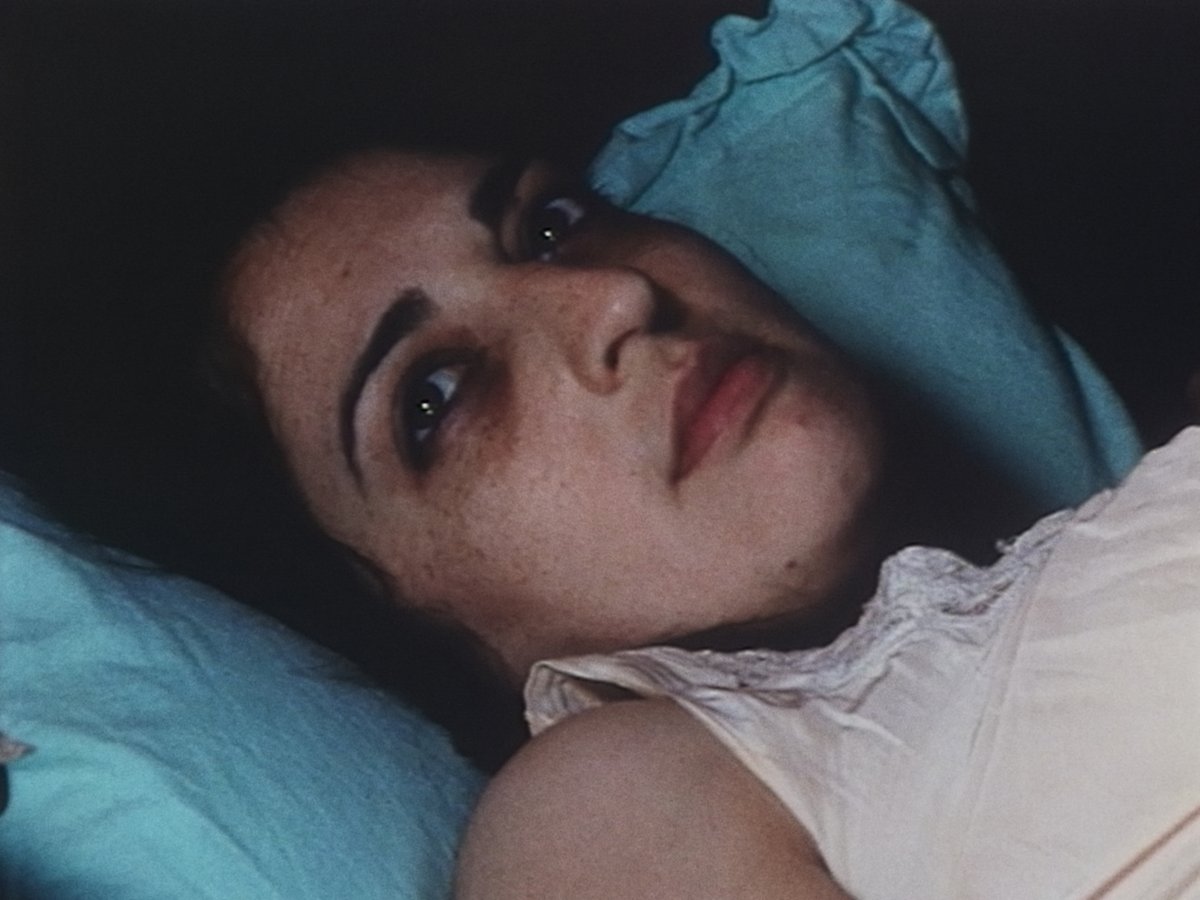
I Will Walk in the Wilderness of This World: Three Films by Parine Jaddo
The 1999 film Aisha (Surviving) opens with a constellation of women, separated by geography and time. A village woman plunges herself fully-clothed into a river. A businesswoman steers through the streets of Washington DC. A filmmaker schemes to make a documentary about her exotic cousin. A disembodied voice whispers in her mother tongue: “Why is it so hard to write?”
The fragments and multiple voices of Aisha invite the viewer into Iraqi-Lebanese filmmaker Parine Jaddo’s trilogy of experimental hybrid films — Atash (Thirst), Aisha (Surviving), Teyh (Astray) — made between 1995–2002 and recently recovered, restored, and presented to the public for the first time this year.
—
Parine Jaddo was born in Baghdad into a secular Turkmani family — a Turkish-speaking people that live in northern Iraq alongside other non-Arab minorities, including the Kurds, Assyrians, and Yezidis. Parine grew up speaking Iraqi Turkman in the home, Arabic on the streets, and when she migrated to Beirut with her family at the age of 8, French and English in school. (This multilingual existence is not unique to the MENA region, but it is worth noting because of the way it carries into her films.)
She spent her college years in Beirut during the brutal civil war, immigrated to the US in 1980 to study business, then worked as an advertising executive in New York, where she recalls with precision: “men with less credentials kept getting promoted above me.” During these years, she would often travel back to Beirut and Baghdad with a small camcorder, where she would film her family, her neighborhood, and the sea. Eventually, the 1991 Gulf War displaced her parents and sister permanently from Iraq to Toronto.
Angered by both US militarism on the one hand, and the misogyny and discrimination of her workplace on the other, Parine enrolled in the graduate film program at Howard University, a historically black college in Washington DC. There, she found hope and resonance in the anticolonial ideas and aesthetics she encountered, largely through the mentorship of filmmakers Haile Gerima, Abiyi Ford, and Alonzo Crawford. But she also found that the patriarchal structures she had navigated throughout her life were also deeply embedded in film education. Her interest in female subjectivity, fractured and multilingual narratives, hybridity, and autofiction confounded some of her instructors. Longing for a language to express a feeling she was still unable to name, she began to conceive of her first short film Atash (Thirst), all the while scanning her own culture for some kind of aesthetic guidance.
I can’t do this because it’s orientalist.
(But is it orientalist if I’m the one creating it?)
Fuck this, she said. And she began filming.
(But is it orientalist if I’m the one creating it?)
Fuck this, she said. And she began filming.
ATASH
In the opening moments of Jaddo’s first film Atash (Thirst), a woman speaks: It is the summer after the war. My mother plants. My sister reads. I cannot find my words. From this autofictional core, Atash unfolds as a story within a story, where fragments from life in post-civil war Beirut lead into a narrated fictional tale of two lovers and fatal madness, until a female voice enters and begins to tell her own version of the story. It is a film of interruptions: a child frequently interrupts his mother from reading, the real and fictive interrupt one another, and the female voice enters to have the last word. Atash means “thirst” in Arabic — a title which brings to mind water and sustenance, but also gestures towards desire and longing, including the desire to voice that which has been self-silenced. Shifting between the authoritative, the fictive, and the personal, the film also alternates between two languages — Arabic and Iraqi Turkman — with Arabic spoken by the male narrator and Turkman spoken by Jaddo herself.
In a free approach to genre, Jaddo recruited a cast of friends and family, including her own parents and sister Yanar, who had fled the Gulf War and were waiting in Beirut for their immigration papers at the time of filming. Emerging cinematographer Alan Ferguson — Jaddo’s peer at Howard University at the time — filmed the fictional storyline of both Atash and the subsequent film Aisha, while the personal fragments in Beirut and Morocco were filmed by Jaddo on her Bolex.
Through this first experiment in personal voice, Jaddo began to forge a cinematic language of autofiction, polyvocality, hybridity, fragmentation, and elliptical rhythms that she would develop further in her second film, Aisha (Surviving).
AISHA
Aisha (Surviving) begins with the voice of an aspiring and arrogant Arab-American filmmaker, Tina, who sets her sights on making a film about her exotic immigrant cousin (Nasreen) — a woman whose inner voice slowly disrupts the orientalizing narrative, revealing an emotional landscape marked by estrangement, cultural dissonance, and desire.
Tina begins her film by interviewing her cousin’s former lovers, one by one. These men are non-actors and friends, sourced from Jaddo’s own community in DC, and their performances tilt the film into a space of ambiguity. Are these moments scripted? Improvised? As each man sits vulnerably in the spotlight, the woman they describe emerges as prismatic and unlocatable, refracted endlessly through the anecdotes of her lovers. As the testimonies unfold, Nasreen is held doubly captive: first through Tina’s obsessive gaze, and then through the men’s stories. But the more aggressively Tina attempts to frame and “know” the real Nasreen, the more the artifice of the film ruptures, giving way to a deep and unvoiced interiority that begins to speak for itself.
This interiority unfolds through moving images drawn from Jaddo’s own archives across digital and analogue formats: images of floating on the sea in Beirut, glimpses of Baghdad through a car window, and the voice of her father recalling the Gulf War. Some of these moments reoccur like a dream image, while others are jarring and dissonant. Through them, we sense that the filmmaker is scanning her own personal archives to piece together an existence marked by rupture and violence.
The film’s emotional core, however, lies in its moments of poetic address. Spoken aloud while the words appear on marbled stone textured with water and sunlight, these vignettes alternate between languages and dialects to transport us through confessions of desire, sadness, longing, and shame. Whether the voice belongs to Jaddo or Nasreen remains unresolved. Rather than distinguishing between filmmaker and character, Jaddo allows them to collapse into a shared emotional register. In the poem “Exile,” she speaks:
I flew west (towards the sunset)
trusting that happiness
was there in the dark.
Now my heart falls a little
At every daybreak.
trusting that happiness
was there in the dark.
Now my heart falls a little
At every daybreak.
TEYH
The third and final film of the trilogy, Teyh (Astray), marks a formal departure into a palette that is more minimalist, durational, and guided by natural light. Filmed on 35mm, Teyh was directed and edited in 2002. It hung in a liminal unfinished fine cut state for 23 years, until its completion and release this year, in 2026.
As Jaddo tells it, she found a box of leftover 35mm “short ends” under a stairwell at Sankofa, near Gerima’s editing studio in DC. They were the leftover film strips of a film he had recently completed, and he encouraged her to use the unused film strips to begin her own project. She then reached out to Howard peer and cinematographer Daniel E. Williams, and together, they began to conceive of a work that would be a study in light and how it moves through a room.
However, September 11th and the US war on terror altered the course of the project, and prompted Jaddo to write an autofictional storyline atop the initial structural focus on natural light and its movement through a home. The film is set in the early aftermath of 9/11, and is guided by the inner thoughts and questions of an unnamed woman spending her days in her DC apartment, questioning her own place in a world that seems to be coming apart. With its commitment to duration, continuity, and a single inner voice, Teyh formally departs from the fragmentation of Atash and Aisha, leaving no ambiguity in its character’s critique of mass media and its relationship to war and western imperialism, while also searching for inner sources of ancestral strength and resolve.
As the voices across Atash, Aisha, and Teyh accumulate, the trilogy reaches an emotional state of al-ghurba (الغربة) — an Arabic word that has no equivalent in English, but that can best be described as a feeling of estrangement, or separation. The root of this word stems from al-gharb, which means “the west,” where the sun sets. Tying the feeling of exile to the fading of light, the word is typically used by Arabic speakers to refer to the condition of being a foreigner in a land away from home, where feelings of loneliness, alienation, and a longing for one’s home and loved ones permeate the psyche. How does one approach existence within such a landscape? What does it look like to “survive,” not just physically, but emotionally and spiritually?
In Atash, Aisha, and Teyh, survival is predicated on voice and experimentation, refusing narrative authority and inherited forms in order to make way for multiple truths and counternarratives, feeling, complexity, and ongoingness. Jaddo’s trilogy calls up the voices of feminist writers like Trinh T. Minh-ha, Theresa Hak Kyung Cha, and Gloria Anzaldúa, who understood that formal experimentation and refusing stable genres was itself a political gesture, one which unsettles the conventions through which knowledge is produced. Her work is also indebted to creative collaboration with artists of colour at Howard University in the mid-1990’s, which encouraged her to work outside, and in critique, of a capitalist and colonial system, rather than within and for it. It is worth noting that Jaddo’s approach does not deny room for play and pleasure. Across the three films, music is uplifted and there is attention to the playful and sensual. (In one scene in Aisha filmed by Lebanese cinematographer Hasan Naamani, the camera pursues a woman through trees while she throws tangerines at the camera.)
If the trilogy begins with the thirst to speak (“I cannot find my words”), it ends with the body — the filmmaker’s own. In the final moments of Teyh, we see Jaddo herself stepping into shoes and exiting the frame. We hear a door open, then slammed as the screen cuts to black. It is an ending which offers no resolution or closure, but reminds one that finding new paths and possibilities sometimes requires pushing beyond the confines of a room or frame or horizon, even if we find ourselves in darkness once again. As spoken in the final moments of Teyh:
I will walk in the wilderness of this world
but I won’t get lost here.
but I won’t get lost here.
——
Notes on the Restoration (and Relation):
Parine Jaddo is my aunt — a woman whose unconventional life I have viewed curiously from a distance for over 40 years. This essay and restoration emerged through conversations we shared from 2022 to 2025 in Toronto and Beirut, and across Viber and WhatsApp. What began as a curiosity about my aunt’s early films deepened into a restoration project when I learned that low-res files were all that remained in her possession. We spent more than a year searching for the original materials, aided immeasurably by her former Howard University collaborator and cinematographer, Daniel E. Williams, who had safeguarded the colour negatives and answer prints of Atash and Teyh in Ohio for over two decades and helped recover a BetaSP tape of Aisha (whose original print and sound is presumed lost). Finally, my aunt and I worked together to conform the 35mm print of Teyh to her 2002 Avid rough cut and bring it to picture lock, further supported by William’s colour notes as the original DP. The process took over three years and took on greater meaning and urgency during the genocide in Gaza and bombings in Lebanon, where she lives, and the horrific destruction of lives, schools, and cultural heritage. I hope this work contributes, in however small a way, to the preservation of vulnerable cinematic histories and encourages others to recover films that might otherwise disappear.
—Nadia Shihab for DIFFUSION 2026